

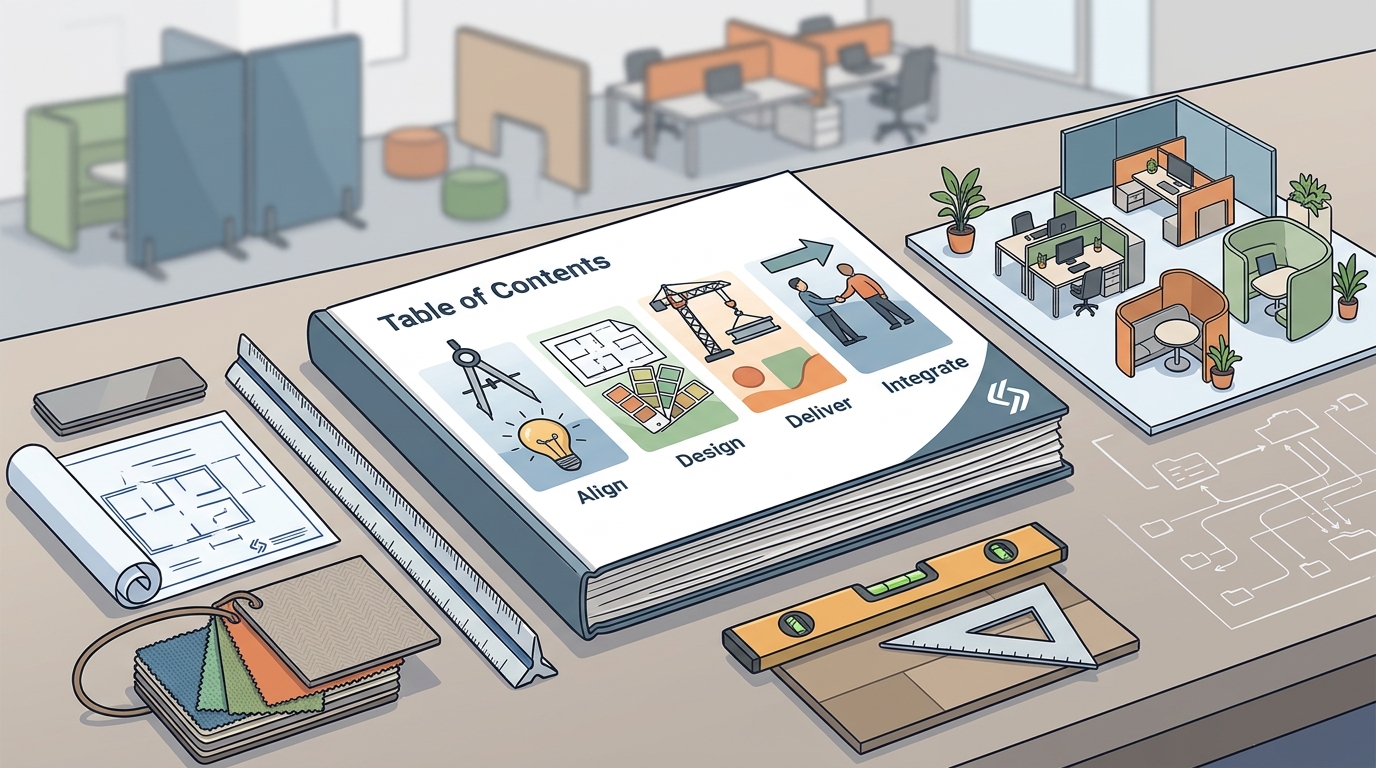
A successful office reconfiguration is a strategic redesign that aligns physical space with how people actually work. It moves beyond cosmetic updates to address workflow, culture, and operational efficiency. Spectrum Workplace approaches this by treating the office as a people problem before a property one, ensuring the final environment supports long-term performance and wellbeing.
Strategic Alignment Before Spatial Planning
Most failed reconfigurations begin with a layout decision rather than a strategic one. A successful project starts by understanding the organization's genuine requirements. This phase involves leadership alignment sessions and structured staff engagement to capture how teams collaborate, focus, and connect. The goal is to create a clear brief that grounds every subsequent design decision in reality rather than assumption.
For example, a financial services firm might discover that confidential client meetings require significantly more acoustic separation than their current layout provides. By identifying this need early, the design team can prioritize private meeting rooms and sound-dampening materials. This ensures the space supports the business model from day one.
Designing for Real Working Patterns
Effective reconfiguration designs for how people actually work, not how leadership imagines they do. This requires a balance between collaborative zones, focused work areas, and social spaces. The design must reflect the organization's real working patterns to ensure high utilization and satisfaction. A well-designed space tells employees that leadership cares about their environment.
Consider a technology company with a predominantly young workforce. Their reconfiguration might include a mix of open-plan workstations for collaboration, quiet focus pods for deep work, and vibrant social hubs for informal interaction. This variety allows employees to choose the environment that best suits their current task, enhancing both productivity and wellbeing.
Technical Coordination and Infrastructure
A visually impressive office that lacks robust technical infrastructure will quickly become frustrating for users. Successful reconfigurations integrate power, data, HVAC, and lighting systems seamlessly into the design. This technical coordination ensures that the space is not only aesthetically pleasing but also fully functional and compliant with safety regulations. It prevents the common issue of desks without power or poor air quality in dense open plans.
For instance, a reconfiguration might involve upgrading the electrical capacity to support high-density workstations and modern AV equipment. It may also include improved ventilation systems to maintain air quality in enclosed meeting rooms. These technical layers are critical for a workplace that performs reliably over the long term.
Managing Disruption During Delivery
Reconfiguring an occupied office requires careful phasing and communication to minimize business disruption. A successful delivery plan keeps the organization running while construction takes place. This involves clear stakeholder communication, strict site management, and a focus on quality control. The project team must coordinate contractors and manage the programme to ensure the office remains usable throughout the process.
For example, a phased approach might allow one floor to be reconfigured while the rest of the organization continues working in the other areas. This requires precise scheduling and coordination to avoid noise and dust affecting active workspaces. Effective management ensures that the transition is smooth and that the business does not suffer during the transformation.
Post-Handover Integration and Adoption
Handover is not the finish line. A successful reconfiguration includes a structured onboarding programme to help staff adapt to the new space. This involves training on new systems, communicating the vision behind the design, and encouraging the use of new facilities. Without this integration, even the best-designed office may be underutilized or misunderstood by its users.
For instance, a company might introduce a booking system for meeting rooms and provide guidance on how to use the new collaboration zones effectively. This ensures that the space is used as intended and that employees feel confident and engaged in their new environment. Long-term adoption is the true measure of a successful reconfiguration.
Key Takeaways
- Start with strategy, not design, to ensure the space aligns with business goals.
- Design for real working patterns, balancing focus, collaboration, and social interaction.
- Integrate technical infrastructure early to avoid functional gaps.
- Manage disruption through careful phasing and clear communication.
- Invest in post-handover integration to ensure long-term adoption and satisfaction.
Frequently Asked Questions
How long does a typical office reconfiguration take?
The duration depends on the scope and complexity of the project. A minor refresh might take a few weeks, while a full reconfiguration of an occupied office can take several months. Careful planning and phasing are essential to manage the timeline effectively.
Do we need to vacate the office during reconfiguration?
Not necessarily. Many reconfigurations are carried out in occupied buildings using a phased approach. This allows the business to continue operating while different areas are updated. However, some areas may need to be vacated temporarily for safety and practical reasons.
What is the most common mistake in office reconfiguration?
The most common mistake is starting with the space rather than the organization. When design begins before the brief is properly understood, the result is often a workplace that reflects assumptions rather than reality, leading to underutilized spaces and low user satisfaction.
How do we measure the success of a reconfiguration?
Success can be measured through user satisfaction surveys, space utilization data, and business performance metrics. A successful reconfiguration should lead to improved collaboration, higher productivity, and a stronger sense of community among employees.
Can we reconfigure our office without moving to a new building?
Yes, an office redesign without relocating can be just as transformational as a full relocation. It allows you to unlock the full potential of your existing space, improving how people collaborate, focus, and connect without the complexity and cost of moving premises.
Start Your Transformation
Ready to rethink how your organization works? Contact Spectrum Workplace to discuss your project. Our team will help you get the thinking right before anything else begins, ensuring your workplace supports your people and your business for the long term.