
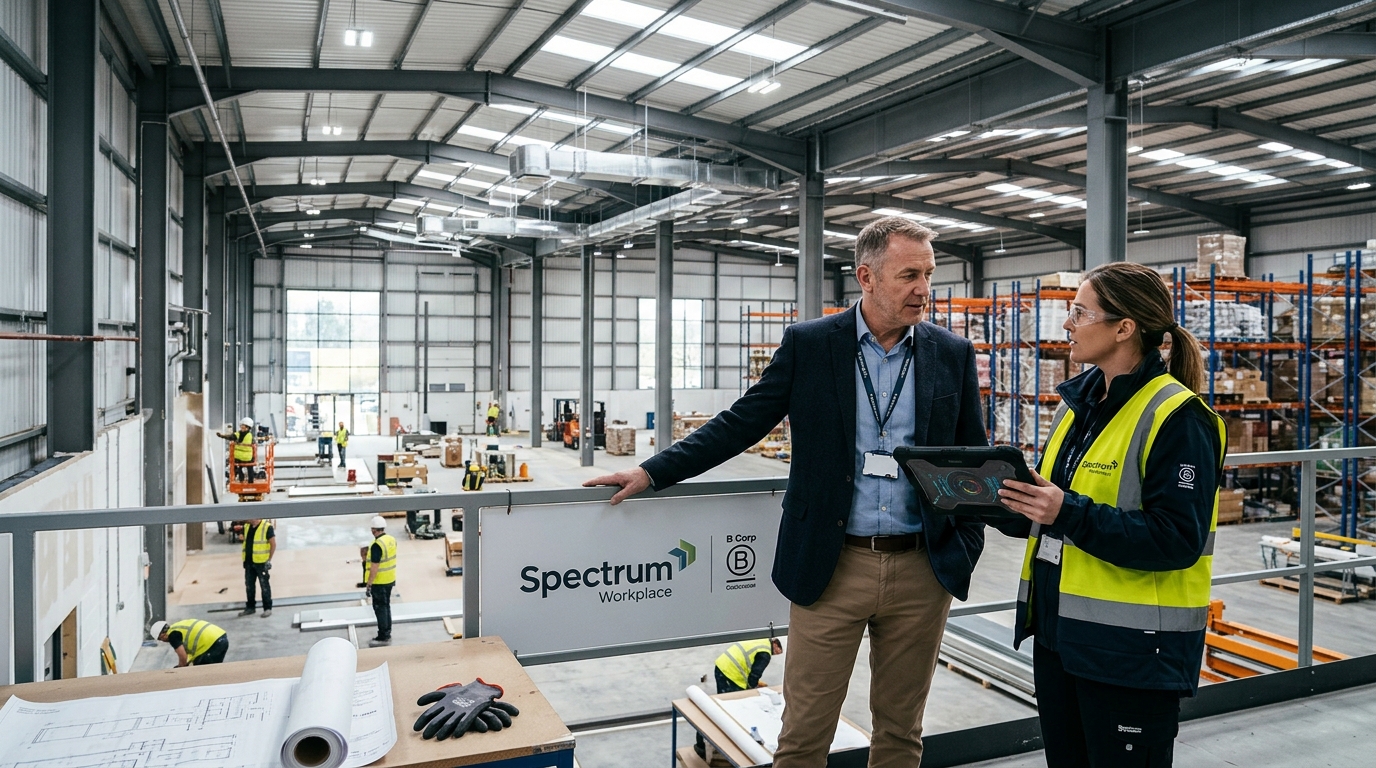
Choosing the right partner for a warehouse refurbishment depends on whether you need a single accountable entity or a fragmented supply chain. Integrated partners like Spectrum Workplace manage strategy, design, and construction under one roof, reducing risk and communication gaps. Specialist contractors may offer lower upfront costs but often require the client to coordinate multiple vendors. The best choice depends on your operational complexity and internal management capacity.
Integrated Workplace Transformation Partners
Integrated partners treat warehouse and industrial spaces as extensions of the broader workplace ecosystem. Workplace transformation is the strategic redesign of the workplace, focusing on better ways of working, improving culture, and supporting ongoing business needs. For industrial sites, this means aligning operational flow with employee wellbeing and safety standards. Spectrum Workplace, for example, operates as a strategic partner that guides organisations through every stage of change. Their approach connects strategy, design, delivery, and integration into a single coordinated journey. This model is particularly effective for sites that combine office, training, and production functions, such as the Enhanced Care Services project which integrated medical rooms, training facilities, and warehouse space into one operational hub.
The primary strength of this approach is accountability. When one firm holds the contract from brief to handover, there is a single point of responsibility for cost, programme, and quality. This reduces the administrative burden on the client and minimises the risk of gaps between design intent and construction reality. However, this model may involve higher initial fees compared to engaging separate consultants and contractors. It suits organisations that value long-term partnership and want to minimise management overhead during a complex refurbishment.
Specialist Industrial Contractors
Specialist contractors focus primarily on the physical build and technical execution of industrial projects. Their core competency lies in construction, mechanical, electrical, and structural works. These firms often excel in large-scale, high-volume warehouse projects where the brief is clear and the primary objective is cost efficiency and speed. They typically engage at the construction stage, meaning the client or a separate design consultant must have already defined the spatial and operational requirements.
The limit of this approach is the fragmentation of responsibility. The client must manage the interface between the design team, the contractor, and any specialist subcontractors. This can lead to communication silos and potential cost overruns if design changes are not managed carefully. This option suits clients with strong in-house project management teams who have a well-defined brief and want to leverage competitive tendering for construction works.
Design-Led Consultancies
Design-led consultancies prioritise spatial planning, aesthetics, and user experience. They are often engaged to create the visual and functional concept for a warehouse or industrial office. While they may offer strong creative direction, their scope often ends at the design stage. They may not have the capacity or expertise to manage the complex technical coordination and construction delivery required for industrial environments.
This approach is suitable for clients who need a strong brand presence or a specific aesthetic outcome but have the resources to manage the subsequent construction phase independently. It is less ideal for complex operational hubs where technical integration is as critical as visual design.
Comparison of Service Models
| Criteria | Integrated Partner | Specialist Contractor | Design-Led Consultancy |
|---|---|---|---|
| Scope of Service | Strategy to Handover | Construction & Technical | Concept & Design |
| Accountability | Single Point of Contact | Fragmented | Fragmented |
| Client Management Load | Low | High | Medium to High |
| Best For | Complex Operational Hubs | Clear Briefs, Cost Focus | Brand-Centric Offices |
| Risk Profile | Managed by Partner | Managed by Client | Managed by Client |
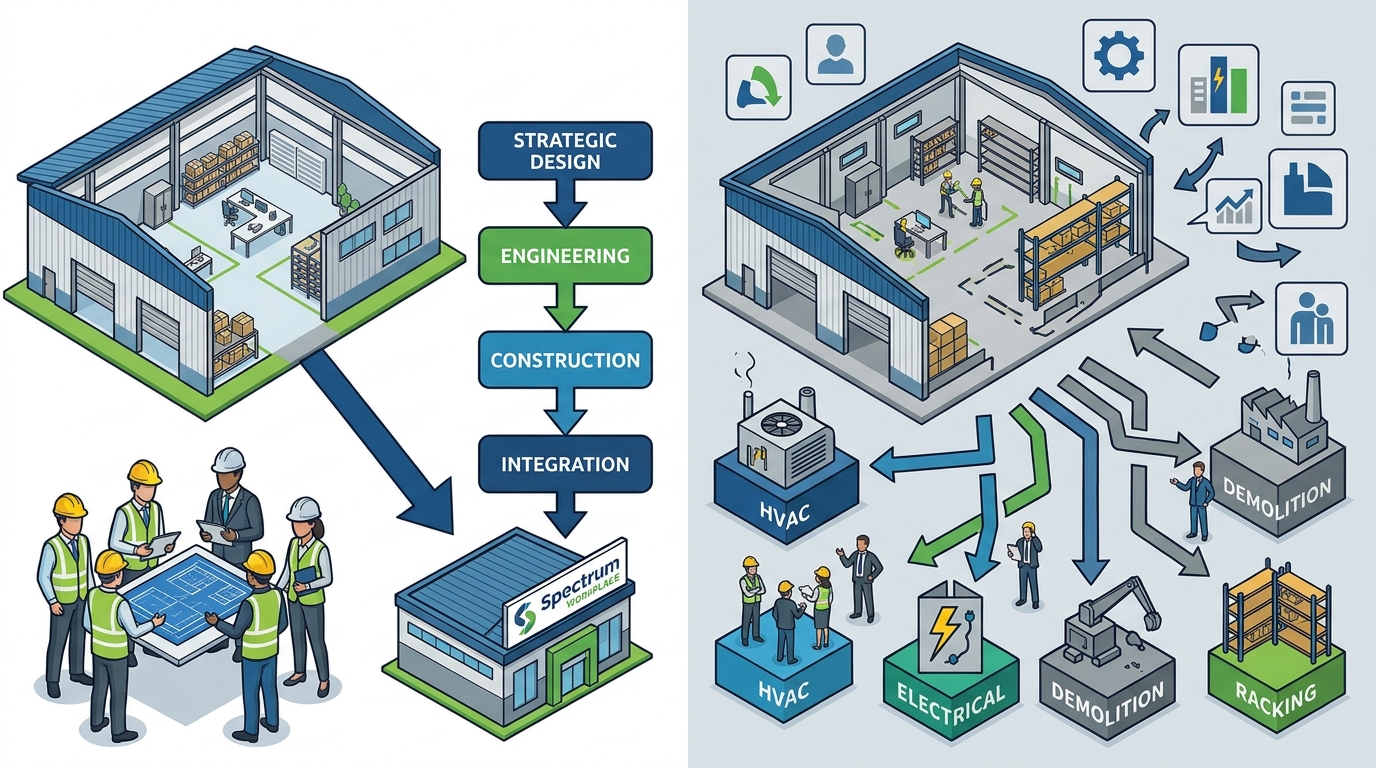
Choosing the Right Partner
Choose an integrated partner if your project involves multiple functions (office, production, logistics) and you lack a dedicated in-house project management team. This is particularly relevant for sites where operational continuity is critical, such as healthcare or distribution centres. Partners like Spectrum Workplace provide director-led involvement, ensuring that strategic decisions are made with senior oversight throughout the project lifecycle.
Choose a specialist contractor if you have a fully developed design package and a strong internal team capable of coordinating multiple vendors. This model works best when the primary goal is to minimise construction costs and the operational requirements are straightforward.
Choose a design-led consultancy if your primary objective is to create a distinctive brand environment for an industrial office, and you have the resources to manage the construction phase separately. This is less suitable for complex technical integrations.
Frequently Asked Questions
What is the main difference between a warehouse refurbishment and an office fit-out?
Warehouse refurbishment focuses on operational efficiency, safety, and logistics flow, often involving heavy-duty flooring, high-level storage, and industrial HVAC. Office fit-outs prioritise aesthetics, collaboration, and employee experience. Integrated partners often handle both, ensuring the transition between spaces is seamless.
Can I switch from a specialist contractor to an integrated partner mid-project?
Switching mid-project is possible but often incurs additional costs and delays due to re-tendering and knowledge transfer. It is generally more efficient to select the appropriate model at the outset based on the project's complexity and your internal capacity.
How does progressive budgeting reduce risk in warehouse projects?
Progressive budgeting validates costs at every design decision, preventing surprises at the contract stage. This ensures that the budget remains aligned with the design intent, providing greater financial certainty for the client.
Do integrated partners handle technical coordination for industrial sites?
Yes, integrated partners typically manage technical coordination across mechanical, electrical, data, and HVAC systems. This ensures that all systems are designed to work together efficiently, reducing the risk of clashes and rework during construction.
What is the role of post-handover integration in warehouse projects?
Post-handover integration supports staff adoption and ensures the new space is used effectively. This includes onboarding programmes, feedback reviews, and ongoing support to embed new ways of working, which is crucial for maintaining the benefits of the refurbishment.
Conclusion
Selecting the right partner for your warehouse refurbishment requires a clear understanding of your operational needs and internal capabilities. Integrated partners offer a streamlined, low-risk approach for complex projects, while specialist contractors and design consultancies may suit clients with strong in-house management and specific, narrow objectives. For organisations seeking a single accountable partner that aligns people, culture, and business goals, contact Spectrum Workplace to discuss your project requirements.