

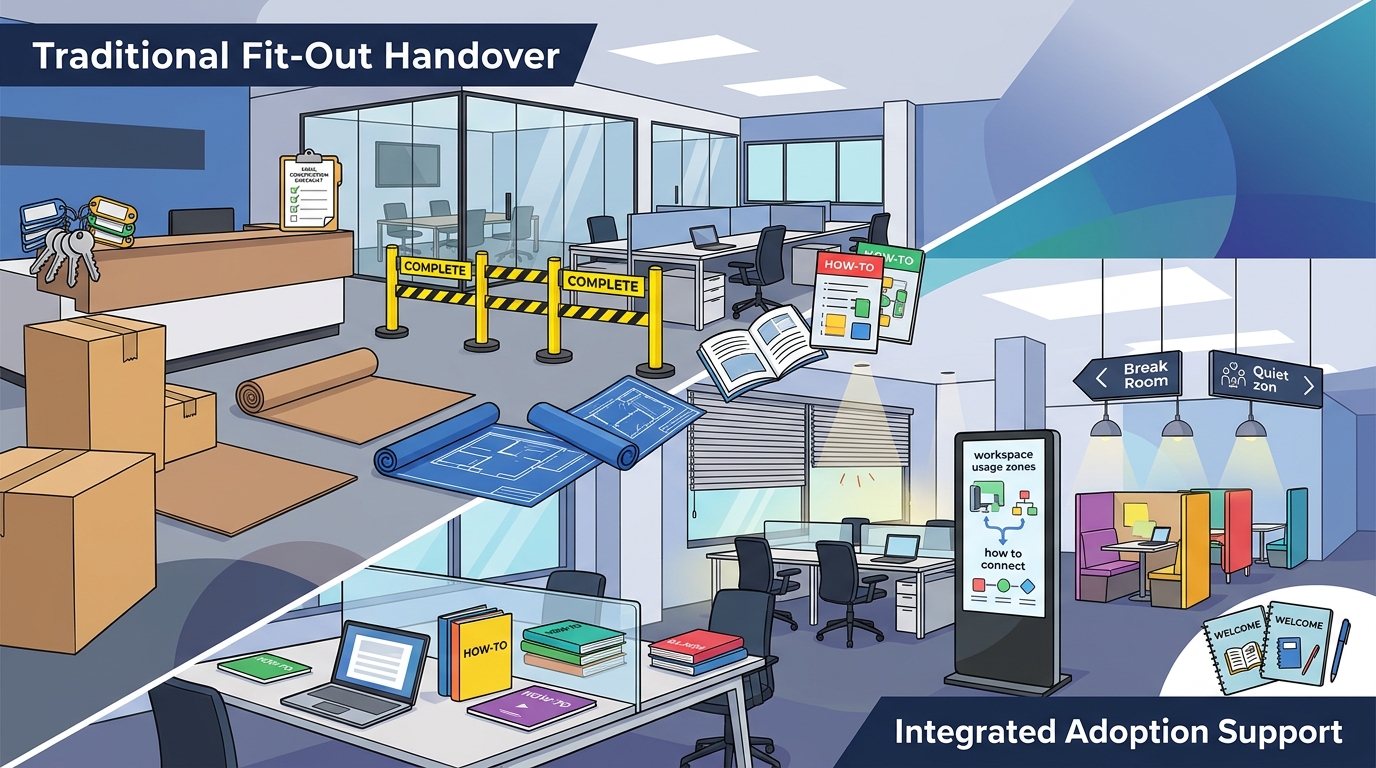
Traditional fit-out handover ends when the building is physically complete, leaving staff to adapt to the new space on their own. Integrated adoption support extends the project lifecycle to include onboarding, communication, and behavioral change management. This distinction determines whether a new office becomes a functional tool or a neglected asset. Spectrum Workplace treats this transition as a critical phase of workplace transformation, ensuring the space is used as intended.
Defining the Traditional Handover Model
Traditional fit-out handover is the formal transfer of a completed construction project to the client, typically marked by the issuance of a certificate of practical completion. In this model, the contractor's responsibility ends once the physical works are finished and signed off. The focus is strictly on the built environment, ensuring that walls, floors, and services meet the technical specifications agreed upon at the start of the project.
This approach relies on the assumption that a well-designed space will naturally be used correctly. However, physical completion does not equal operational success. Without guidance, employees often revert to old habits, ignoring new collaborative zones or misusing quiet focus areas. The result is a high-quality asset that fails to deliver its intended productivity benefits. The gap between design intent and daily reality is where value is often lost in traditional models.
The Role of Integrated Adoption Support
Integrated adoption support is a structured program of communication, training, and engagement that runs alongside and after the physical build. It focuses on the human element of workplace change, helping staff understand why the space has changed and how to use it effectively. This model recognizes that a workplace is a system of people, processes, and places, not just a collection of rooms.
At Spectrum Workplace, this is the fourth stage of our transformation framework, known as Integrate. We do not view onboarding as an afterthought but as a core service. This stage involves pre-move communications, staff briefings, and post-move feedback loops. By actively participating in the transition, we help embed new ways of working. The goal is to ensure that the workplace creates value because people use it well, not just because it looks good.
Operational Differences in Project Lifecycle
The primary operational difference lies in the duration and scope of the partner's involvement. Traditional handover is a discrete event, often occurring on a specific date when keys are handed over. Integrated adoption support is a continuous process that begins before the move and continues for weeks or months afterward. This extended timeline allows for the monitoring of space utilization and the adjustment of strategies based on real-world feedback. according to What Is Strategic
Consider the case of DPS Games, a client of Spectrum Workplace. Their 35,000 sq ft refurbishment in Guildford included a central staff deli designed to act as a social hub. In a traditional model, the project would end when the deli was built. With integrated support, the team facilitated the cultural shift required to use the space for informal collaboration, not just eating. This distinction ensures that the investment in social infrastructure translates into actual team connection and culture building.
Risk Mitigation and Long-Term Value
Traditional handover carries a higher risk of underutilization. When staff are not guided, they may avoid new spaces due to uncertainty or discomfort. This leads to wasted square footage and a return to inefficient working patterns. Integrated adoption support mitigates this risk by reducing friction. It provides the confidence and knowledge needed for employees to embrace the new environment. This proactive approach protects the return on investment for the organization.
Furthermore, integrated support helps leadership teams maintain alignment. Workplace change can be disruptive, and without clear communication, it can lead to resistance or disengagement. By managing the narrative and providing consistent support, the project team helps preserve morale and productivity during the transition. This is particularly important for organizations undergoing significant growth or restructuring, where the workplace is a key tool for reinforcing new cultural values.
Choosing the Right Partner for Your Project
Selecting a partner who offers integrated adoption support requires looking beyond construction capabilities. You need a team that understands organizational behavior and change management. Spectrum Workplace brings together workplace strategy, design, and delivery under one roof, with director-level involvement on every project. This ensures that the human element is never lost in the technical details of the build.
Key Takeaways
- Traditional handover ends at physical completion, while integrated adoption support continues through the behavioral transition.
- Integrated support reduces the risk of space underutilization by guiding staff on how to use new environments.
- Workplace transformation is a people problem, not just a property one, requiring active engagement and communication.
- Post-move feedback and space utilization reviews are critical components of the integrated model.
- Partners like Spectrum Workplace treat onboarding as a core service, not an optional extra.
- Long-term value is protected when the design intent is reinforced through ongoing adoption strategies.
Frequently Asked Questions
What is the main difference between handover and adoption support?
Handover is the physical transfer of the completed building, whereas adoption support is the ongoing process of helping staff use the space effectively and embrace new ways of working.
Why is adoption support important after a refurbishment?
It ensures that the investment in the new space delivers its intended benefits by reducing friction and helping employees adapt to the new environment.
Does Spectrum Workplace provide adoption support?
Yes, Spectrum Workplace includes workplace integration and onboarding as a core stage of its transformation framework, ensuring the space is used as designed.
How long does adoption support typically last?
It varies by project, but it generally extends from pre-move communications through to post-move feedback and space utilization reviews.
Can traditional handover still be successful?
It can be, but it relies heavily on the organization's internal ability to manage change, which is often a resource constraint.
What role does leadership play in adoption?
Leadership must champion the change and model the desired behaviors, while the project partner provides the tools and communication to support this shift.