

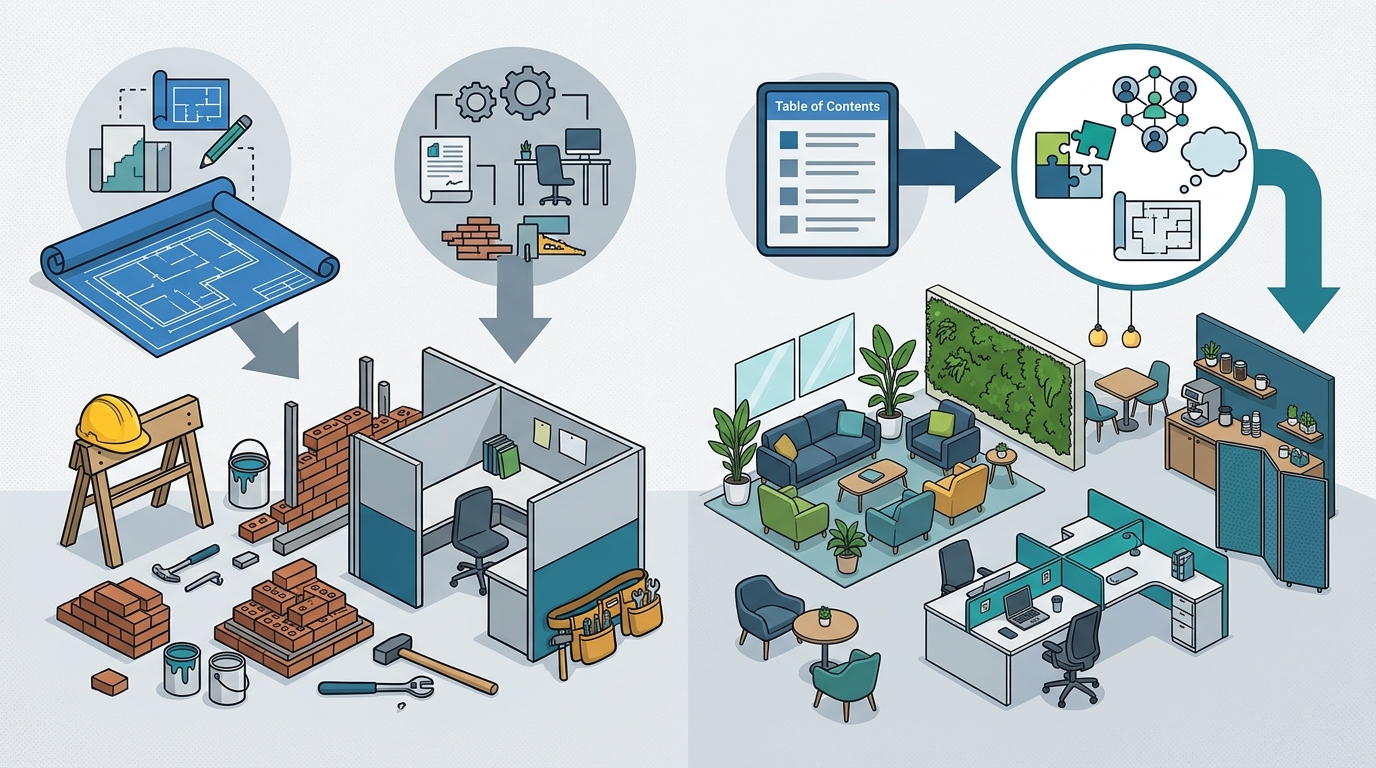
Workplace transformation partners differ from traditional office fit out contractors by focusing on organizational strategy and culture before physical construction begins. While contractors execute technical builds, transformation partners align space with business goals, ensuring the final environment supports long-term productivity and employee wellbeing. This strategic approach prevents the common pitfall of delivering a beautiful but functionally misaligned office.
Strategic Briefing vs. Technical Execution
The primary distinction lies in the starting point of the project. A traditional fit out contractor typically begins with a fixed layout and a set of technical requirements. Their role is to build what is drawn on the plans. In contrast, a workplace transformation partner starts with a strategic brief. This phase involves deep research into how the organization actually works, not just how it claims to work.
Workplace strategy is the process of defining the business objectives that the physical space must support. It asks questions about collaboration patterns, talent retention, and brand perception. For example, a financial services firm might need a balance of private focus zones for compliance-heavy work and open areas for client-facing collaboration. A transformation partner identifies these needs early. This ensures that the design decisions made later are grounded in business reality rather than aesthetic preference alone.
At Spectrum Workplace, this strategic phase is the foundation of every project. By investing time in understanding the client's culture and operational needs, the team ensures that the subsequent design and construction phases have a clear direction. This prevents the costly and time-consuming changes that often occur when a contractor realizes mid-build that the space does not fit the client's actual workflow.
Integrated Service Delivery
Traditional fit out projects often involve a fragmented supply chain. The client may hire a separate architect, a separate mechanical and electrical engineer, and a separate main contractor. This fragmentation can lead to communication gaps and conflicting priorities. A workplace transformation partner, however, offers an integrated service model. They manage the entire lifecycle under one roof, from initial strategy through to final handover.
This integration is critical for managing complexity. When strategy, design, and construction are handled by one accountable partner, decisions are made with the whole project in mind. For instance, a design choice for a collaborative zone must be tested against the technical capacity of the HVAC and data systems. An integrated team can resolve these conflicts immediately. A fragmented team may require multiple rounds of coordination, delaying the project and increasing costs.
Spectrum Workplace operates as a multidisciplinary partner, bringing together workplace consultants, interior architects, and construction managers. This structure allows for seamless coordination between creative intent and engineering reality. The client benefits from a single point of contact who understands the full scope of the project. This reduces the administrative burden on the client's leadership team, allowing them to focus on their core business rather than managing a web of external vendors.
People-Centric Design and Culture
Traditional contractors often view the office as a static asset. Their goal is to deliver a compliant and functional building. A transformation partner views the office as a dynamic tool for shaping culture. They understand that the physical environment influences behavior, trust, and innovation. This perspective leads to a people-centric design approach that prioritizes the employee experience.
Workplace culture design is the practice of using spatial layout to foster specific organizational behaviors. For example, placing informal breakout areas near high-traffic corridors encourages accidental interactions between different departments. This type of subtle design intervention can break down silos and improve communication. A traditional contractor may install the furniture, but they are unlikely to consider the sociological impact of its placement. A transformation partner considers these factors as part of the core design brief.
Research indicates that employees who feel connected to their workplace are more engaged and less likely to leave. By designing spaces that support connection and wellbeing, transformation partners help organizations retain talent. Spectrum Workplace emphasizes this aspect of their service, ensuring that the final space reflects the client's values and supports their people. This focus on the human element distinguishes them from contractors who focus primarily on the physical structure.
Long-Term Performance and Adaptability
Traditional fit out projects often end at handover. The contractor delivers the keys, and their involvement ceases. A workplace transformation partner, however, considers the long-term performance of the space. They design for adaptability, recognizing that business needs will change over time. This forward-thinking approach ensures that the investment remains relevant for years, not just months.
Adaptability is a key feature of modern workplace design. It allows the space to evolve as the organization grows or shifts its working model. For example, a hybrid working model requires a different spatial configuration than a traditional five-day office. A transformation partner designs with this flexibility in mind, using modular furniture and adaptable zoning. This reduces the need for costly future renovations. A traditional contractor may deliver a rigid layout that becomes obsolete as soon as the company's working practices change.
Spectrum Workplace supports clients beyond the initial handover. They monitor how the space is used and provide recommendations for ongoing optimization. This post-handover support ensures that the workplace continues to perform as intended. It transforms the office from a static asset into a living environment that supports the organization's long-term success. This commitment to long-term value is a hallmark of a true transformation partner.
Risk Management and Budget Certainty
Traditional fit out projects are often associated with budget overruns and schedule delays. This is frequently due to a lack of early cost visibility and poor coordination between design and construction. A workplace transformation partner mitigates these risks through progressive budgeting and rigorous project governance. They provide cost certainty from the earliest stages of the project.
Progressive budgeting is a method where cost estimates are refined and validated as the design develops. This approach ensures that the client knows the true cost of the project before committing to a contract. It eliminates the surprise variations that can derail a traditional fit out. By integrating cost management with the design process, transformation partners provide a level of financial transparency that is rare in the construction industry.
Spectrum Workplace uses a progressive budgeting approach to manage risk. This allows clients to make informed decisions with confidence, knowing that the final cost will align with their budget. This level of certainty is crucial for organizations with strict financial controls. It demonstrates the partner's commitment to delivering the project on time and within budget, a key differentiator from traditional contractors who may prioritize their own profit margins over the client's financial interests.
Key Takeaways
- Workplace transformation partners focus on strategy and culture before construction, unlike traditional contractors who focus on technical execution.
- Integrated service delivery reduces communication gaps and ensures that design, engineering, and construction are aligned.
- People-centric design prioritizes employee experience and organizational culture, leading to higher engagement and retention.
- Long-term adaptability ensures that the workplace remains relevant as business needs and working models evolve.
- Progressive budgeting provides cost certainty and reduces the risk of overruns and delays.
- Post-handover support ensures that the space continues to perform and supports the organization's long-term goals.
Frequently Asked Questions
What is the main difference between a fit out contractor and a transformation partner?
The main difference is the starting point. A fit out contractor starts with a design and builds it. A transformation partner starts with a strategic brief and designs the space to meet business goals.
Do transformation partners handle construction?
Yes, most transformation partners manage the entire process, including construction. They act as a single point of contact, coordinating all aspects of the project.
Is a transformation partner more expensive than a contractor?
Not necessarily. While the strategic phase may involve additional fees, the overall cost is often lower due to reduced changes, better budget control, and long-term adaptability.
How long does a workplace transformation take?
The timeline depends on the project size and complexity. The strategic phase adds time to the front end, but it often saves time during construction by preventing delays.
Can a transformation partner work with our existing architect?
Yes, transformation partners can collaborate with existing architects. They provide the strategic direction and manage the overall process, ensuring the architect's work aligns with business goals.
What industries benefit most from workplace transformation?
Industries with high talent competition, such as technology, finance, and professional services, benefit most. However, any organization looking to improve culture and productivity can benefit.
Conclusion
Choosing between a traditional fit out contractor and a workplace transformation partner depends on your organization's goals. If you need a simple, static build, a contractor may suffice. However, if you want a space that drives culture, supports growth, and performs for the long term, a transformation partner is the better choice. Spectrum Workplace offers this comprehensive approach, guiding you from strategy to integration and ensuring your workplace truly works for your people. according to What is an